Choosing the right eyeglass lenses can feel confusing with so many optical terms. But here is the secret: lens types simply come down to how many viewing zones (focal points) you need throughout your day.
The Core Rule of Lens Selection
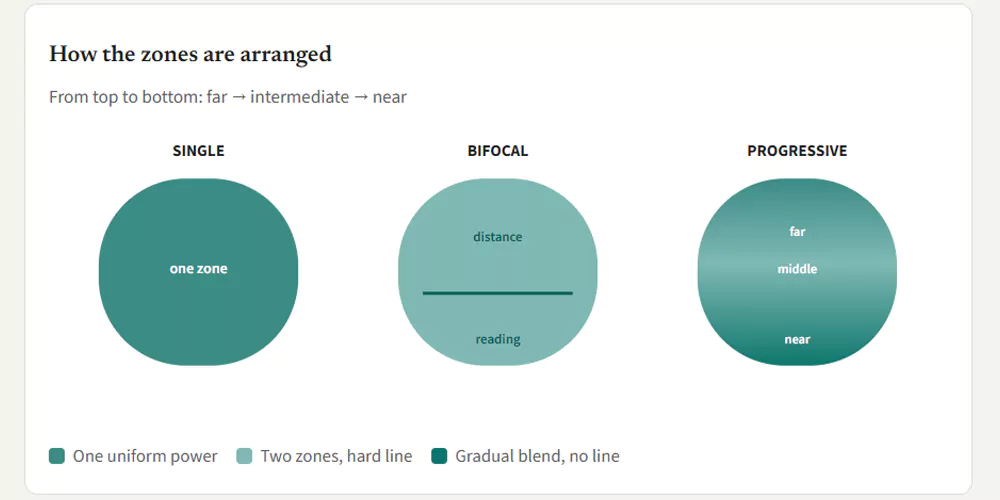
A Single Vision lens has 1 zone[cite: 8].
A Bifocal has 2 distinct zones[cite: 8].
A Progressive lens provides a continuous gradient from top to bottom with no visible lines[cite: 8]. As our eyes naturally age (a normal condition called presbyopia), our vision often requires help at multiple distances[cite: 8].
Single Vision Lenses — One Power
The most common and affordable lens type worldwide[cite: 8]. Single vision lenses contain one uniform prescription power across the entire surface[cite: 8].
Distance Lenses
Designed for everyday far vision—driving, watching movies, and seeing across the room[cite: 8]. Ideal for all-day wear[cite: 8].
Reading Lenses
Designed specifically for close-up tasks like reading books, using smartphones, or fine detail work at arm's length[cite: 8].
Bifocal Lenses — Two Powers
When you need help with both distance and reading vision, bifocals combine both prescriptions into a single lens separated by a visible horizontal line[cite: 8].
How It Works
Look straight ahead through the upper section for distance vision; look down through the lower segment for reading[cite: 8].
The Trade-off
There is a visible line on the lens and an "image jump" when switching focus[cite: 8]. It also lacks an intermediate zone for computer screens[cite: 8].
Progressive Lenses — Seamless Multi-Focus
The modern upgrade to bifocals. Progressive lenses offer a smooth, line-free transition from far vision at the top, computer distance in the middle, to reading vision at the bottom[cite: 8].
Driving, watching TV, and outdoor activities[cite: 8].
Desktop computers, car dashboards, and cooking[cite: 8].
Smartphones, reading, and close-up hobbies[cite: 8].
Which Lens Type Is Right for You?
| Lens Type | Best Suited For | Key Advantages |
|---|---|---|
| Single Vision (Distance) | People needing one power for far vision[cite: 8] | Thinnest, simplest, widest field of view[cite: 8] |
| Single Vision (Reading) | People who only struggle with close-up tasks[cite: 8] | Ideal for dedicated reading session clarity[cite: 8] |
| Bifocal Lenses | Presbyopia needing far near focus with budget priority[cite: 8] | Two distinct visual zones, easy to adapt[cite: 8] |
| Progressive Lenses | Presbyopia wanting all-in-one vision with no visible line[cite: 8] | Seamless clear vision from distance to computer screen to mobile phone[cite: 8] |
The Bottom Line
There is no single "best" lens type—the right choice depends on your age, daily screen habits, and personal lifestyle preferences[cite: 8]. Discussing your daily routine with your optician ensures you get the perfect visual comfort[cite: 8].
Need Custom Prescription Lenses?
Explore our high-quality Single Vision, Anti-Fatigue, and Progressive lens options customized to your exact prescription.