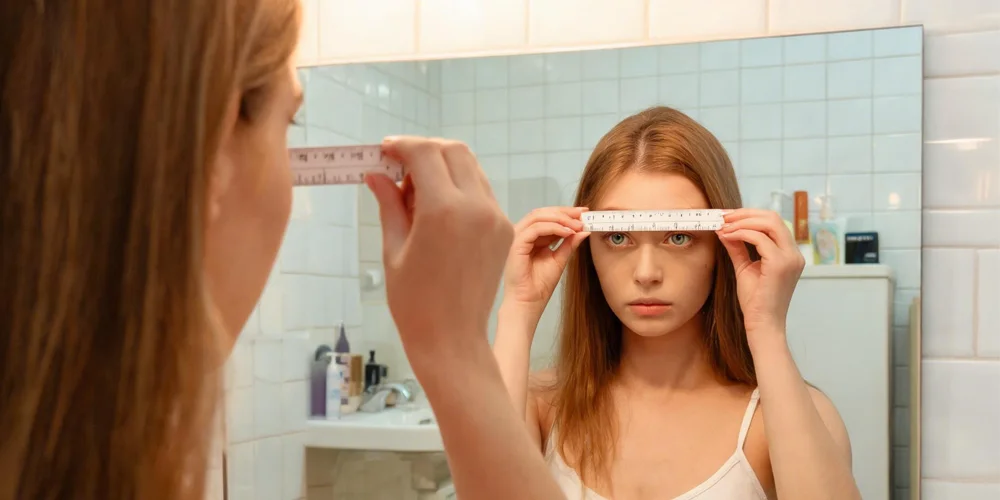
You got your prescription right, picked the perfect frames, and waited patiently for your new glasses to arrive. But when you put them on, something feels … off. Blurry vision, headaches, or just a nagging feeling that things aren't quite right. The culprit? A wrong PD.
What Actually Happens When Your PD Is Wrong?
Your PD (pupillary distance) tells the lens lab where to place the optical center of each lens — the point where your vision is sharpest. When that center doesn't line up with your pupil, light bends incorrectly through the lens. This misalignment creates an unwanted prismatic effect — essentially, your lenses are bending light in a way they weren't designed to.
Think of it like this: looking through a pair of binoculars that aren't adjusted to your eyes. Everything is technically there, but nothing feels quite right.
The result? Your eyes have to work harder to compensate. And over time, that extra effort adds up.
The 7 Most Common PD Mistakes
Mistake #1: Guessing Your PD
This is the single most frequent error. Many people assume PD is a flexible number that can be roughly estimated. It's not. PD is a precise measurement in millimeters. Guessing — even by 1–2 mm — can cause noticeable problems, especially with stronger prescriptions.
Mistake #2: Using an Old PD Number
Your PD can change slightly over time, especially as your face changes with age. Using a PD from a prescription written years ago is a common pitfall.
Mistake #3: Measuring PD Incorrectly at Home
DIY PD measurement is tricky. Common errors include:
- Measuring from the wrong point — PD is center-pupil to center-pupil, not from eyelids, iris edges, or eye corners.
- Not looking straight ahead — your eyes should look directly forward; looking sideways skews the result.
- Holding the ruler crooked or at an angle — this creates parallax error.
- Using poor lighting — makes it hard to see pupil centers clearly.
- Rushing the measurement — taking a single reading instead of repeating for consistency.
Mistake #4: Confusing Near PD with Distance PD
When you look at something close, your eyes converge (turn inward). That means your Near PD is about 3 mm smaller than your Distance PD. If you're ordering reading glasses or progressive lenses but enter your Distance PD instead of your Near PD, the alignment will be off.
Mistake #5: Using Single PD When You Need Dual PD
Most people's faces aren't perfectly symmetrical — one eye might be 1–2 mm closer to the nose bridge than the other. A Single PD (one number) treats both eyes as perfectly centered. A Dual PD (two numbers, one for each eye) accounts for asymmetry and is more precise.
Mistake #6: Not Getting Your PD from a Professional
Many people don't realize that PD isn't always included on a standard prescription. So they either guess or struggle through a DIY measurement.
Mistake #7: Choosing Frames That Are Too Wide for Your PD
Even with a perfect PD measurement, if your frames are too wide, the optical centers may not align properly with your eyes. This is called decentration — the lenses have to be shifted to fit the frame, which can introduce distortion.
How to Spot a Wrong PD: 7 Warning Signs
If your PD is off, you might experience these symptoms:
| Symptom | What It Feels Like |
|---|---|
| Eye strain | Eyes feel tired or "worked" after short periods of use |
| Headaches | Especially above the eyes or across the forehead |
| Blurry or distorted vision | Things look slightly out of focus, especially straight ahead |
| Dizziness or nausea | A "swimmy" feeling, especially when moving your head |
| Double vision | Seeing two images instead of one |
| Difficulty focusing | Eyes struggle to lock onto text or objects |
| "Something feels off" | A vague discomfort you can't quite pinpoint |
Who Is Most at Risk?
PD errors affect everyone, but some people are more sensitive than others:
Even a 1 mm error can cause significant prismatic effect.
These lenses have multiple vision zones that need precise alignment.
One eye is closer to the nose than the other.
Unfamiliar with the PD measurement process.
Note: For low prescriptions (under ±3.00D) with single vision lenses, a 1–2 mm error may not be noticeable. But why take the risk?
How to Avoid PD Mistakes: Quick Checklist
-
✓
Ask your eye doctor for your PD during your next eye exam — and ask for it in writing.
-
✓
Use a professional measurement if possible — a pupillometer is the most accurate tool.
-
✓
If measuring at home: use good lighting, hold the ruler flat, look straight ahead, and repeat 3 times.
-
✓
Know which PD you need: Distance PD vs. Near PD, Single PD vs. Dual PD.
-
✓
Match your frame width to your PD: avoid frames that are much wider than your face.
-
✓
Double-check what you enter when ordering online: one typo can ruin your glasses.
What to Do If You Suspect Your PD Is Wrong
- Stop wearing the glasses if they're causing significant discomfort.
- Get your PD re-measured by a professional.
- Compare the new measurement with what you entered on your order.
- Contact the retailer — most reputable online glasses stores will remake your lenses if the PD was entered incorrectly.
- Request a remake using the correct PD.
The Bottom Line
A wrong PD won't permanently damage your eyes. But it can make your glasses uncomfortable, frustrating, and sometimes unwearable. The good news? It's entirely avoidable. Take the extra five minutes to get your PD right — your eyes (and your head) will thank you.
Need help with your PD?
Contact our customer service team or use our online PD measurement tool for a free, accurate reading.