If you're ordering progressive lenses, your PD measurement suddenly becomes a lot more important. Here's why — and how to get it right.
What Are Progressive Lenses?
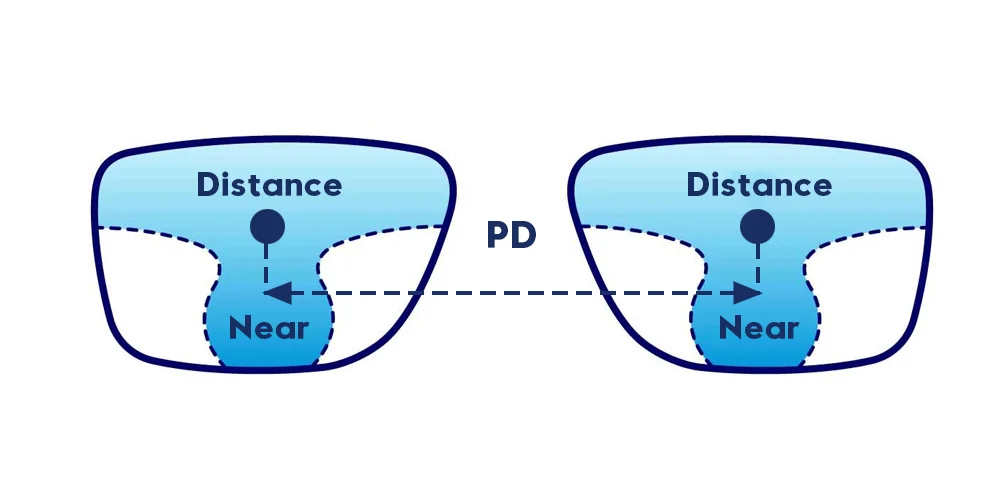
Progressive lenses (also called progressive addition lenses, or PALs) are multifocal lenses that correct vision at three distances — distance, intermediate, and near — all in one seamless lens.
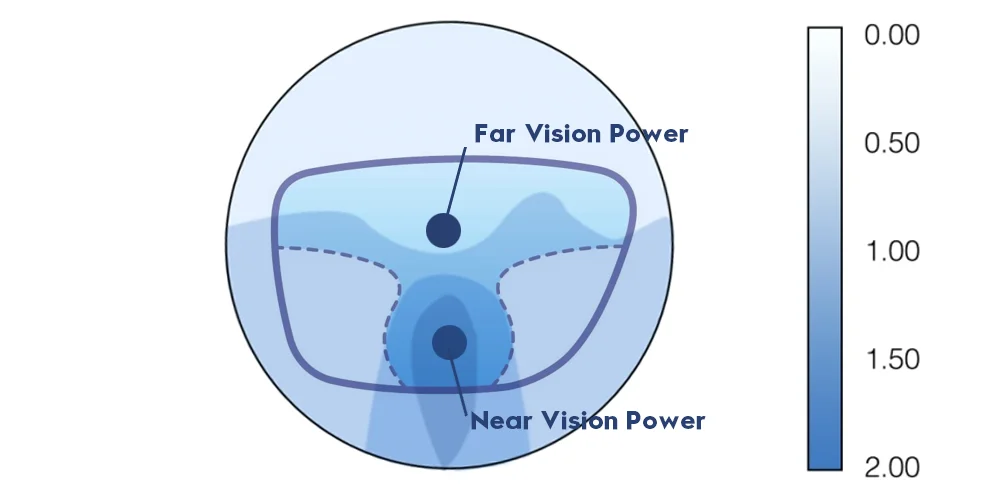
Unlike bifocals or trifocals, progressives have no visible dividing lines between the vision zones. The power transitions smoothly from the top of the lens (distance) through the middle (intermediate/computer range) to the bottom (reading).
Here's the catch: progressives are position-sensitive optics. Move the lens a couple of millimeters, and the intended vision zones no longer line up with where your eyes actually look. That's why progressive lenses demand far more precise measurements than single-vision lenses .
Why Does PD Matter More for Progressives?
With single-vision lenses, the entire lens has one power . Even if the optical center is slightly off, you're still looking through the same prescription — just maybe not the clearest part .
Progressive lenses are different . Each zone — distance, intermediate, and near — occupies a specific area of the lens . If your PD is wrong, those zones shift sideways . You might find yourself:
- "Hunting" for clarity — tilting your head to find the right spot
- Getting clear vision in one eye but not the other
- Feeling like the reading zone is "just out of reach"
- Developing eye strain that builds throughout the day
"You can have a 'perfect' prescription and still hate your progressive lenses . When someone tells us they're seeing swim, blur, headaches, or they can't find the reading zone, the problem is often not the lens brand or the prescription strength . It's the fitting measurements ."
Monocular PD vs. Binocular PD: Which One for Progressives?
| Feature | Binocular PD | Monocular PD |
|---|---|---|
| What it measures | Total distance from pupil to pupil | Distance from each pupil to nose bridge |
| Format | One number (e.g., 63 mm) | Two numbers (e.g., 32/31) |
| Assumes | Face is perfectly symmetrical | Face may be asymmetrical |
| For progressives? | ❌ Not recommended | ✅ Required |
Progressive lenses require monocular PD . Most people's faces aren't perfectly symmetrical . The distance from your nose bridge to your right pupil might be 32 mm, while the left is 31 mm . A binocular PD of 63 mm split in half (31.5/31.5) would be wrong for both eyes .
"A binocular PD that is simply split in half ignores facial asymmetry and can cause adaptation problems ."
The Tolerance Is Tight — Really Tight
The ANSI Z80.1-2015 standard sets the monocular PD tolerance for progressive lenses at ±1.0 mm per eye .
PD Tolerance: ±2.5 mm total
PD Tolerance: ±1.0 mm per eye
Even a 2–3 mm error in PD measurement can cause eye strain, headaches, and reduced visual acuity — especially with progressive lenses .
Distance PD vs. Near PD — Two Different Numbers
When you look at something far away, your eyes point straight ahead — parallel . That's your Distance PD . When you look at something close (like a book or phone), your eyes turn inward to converge . That's your Near PD — and it's typically about 3–4 mm smaller than your Distance PD .
For progressive lenses, both matter . The distance zone needs your Distance PD, while the reading zone needs your Near PD . If the near inset is wrong, the reading zones land too far toward your nose or too far outward — and you'll feel like you're always "just missing" the sharp area .
Common Symptoms of a Wrong PD for Progressives
If your PD is off when wearing progressive lenses, you might experience :
| Symptom | What It Feels Like |
|---|---|
| Eye strain | Eyes feel tired after short periods of use |
| Headaches | Especially above the eyes or across the forehead |
| Blurry or distorted vision | Things look slightly out of focus, especially straight ahead |
| Dizziness or nausea | A "swimmy" feeling when moving your head |
| Double vision | Seeing two images instead of one |
| "Something feels off" | A vague discomfort you can't quite pinpoint |
| One eye is clear, the other isn't | The reading zone lands differently for each eye |
Quick Checklist — Before You Order Progressive Lenses
-
✓
Get a monocular PD — two numbers (right eye / left eye), not one .
-
✓
Know your Distance PD — for the top portion of the lens .
-
✓
Know your Near PD — for the reading portion (about 3–4 mm smaller) .
-
✓
Aim for ±1.0 mm accuracy — that's the ANSI standard for progressives .
-
✓
Have it measured professionally if possible — it's worth the extra effort .
-
✓
If measuring at home, repeat multiple times and be very careful .
The Bottom Line
Progressive lenses are an engineering marvel — but they're only as good as the measurements they're built on . A wrong PD won't just make your glasses uncomfortable; it can make them practically unwearable .
Take the extra time to get your monocular PD measured accurately — your eyes (and your head) will thank you .
Ready to order progressive lenses?
Make sure you have your monocular PD ready. Need help measuring? Contact our support team or use our online PD tool.