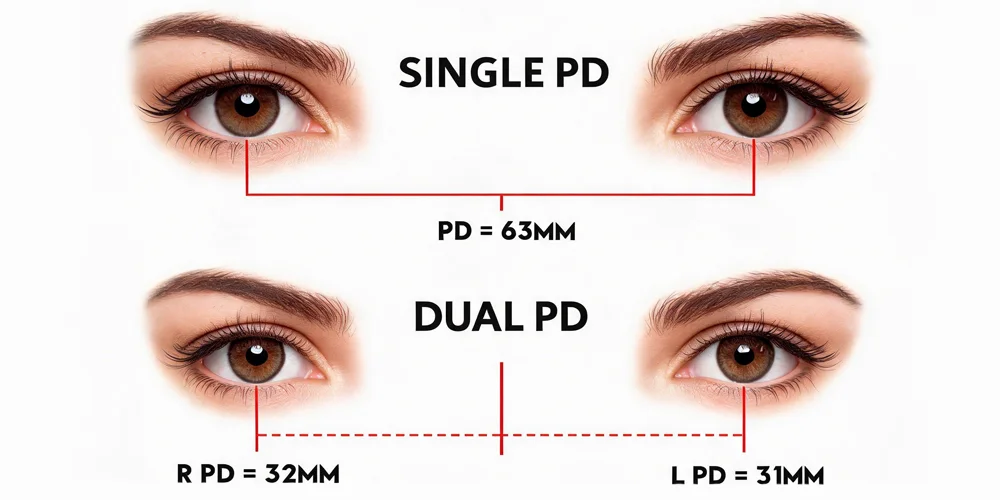
If you’re ordering glasses online, you’ll likely see a box asking for your PD. But then you might notice two options: Single PD and Dual PD. What’s the difference, and which one should you choose? Let’s break it down in plain English.
Quick Recap: What Is PD?
PD stands for Pupillary Distance – it’s simply the distance between the centers of your two pupils, measured in millimeters (mm).
This number tells the lens lab exactly where to place the optical center of each lens so that it lines up perfectly with your eyes. If your PD is wrong, even a spot‑on prescription can leave you with blurry vision, headaches, or eye strain.
For most adults, PD falls somewhere between 54 mm and 74 mm, with an average around 63 mm.
What Is Single PD?
Single PD (also called binocular PD) is the total distance from the center of one pupil to the center of the other. It’s given as one single number, for example "63 mm".
Single PD = one number = total distance between both eyes
This is the most common format you’ll see on prescriptions. It’s simple and works well for the majority of people.
What Is Dual PD?
Dual PD (also called monocular PD) measures the distance from each pupil to the bridge of your nose separately. It’s given as two numbers, for example "32/31".
Dual PD = two numbers = right eye-to-bridge / left eye-to-bridge
The first number is usually for your right eye (OD), and the second for your left eye (OS). So "32/31" means 32 mm from your right pupil to the nose bridge, and 31 mm from your left pupil to the bridge.
The Key Difference at a Glance
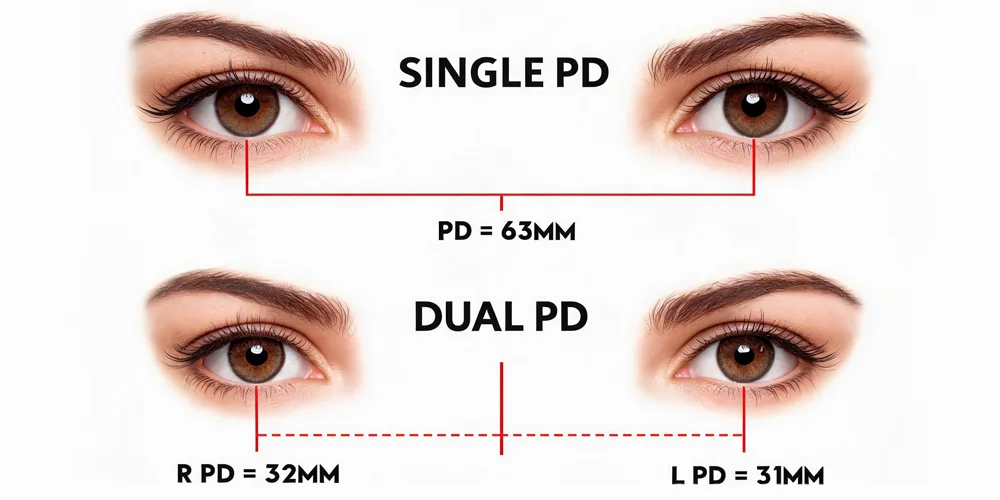
| Feature | Single PD | Dual PD |
|---|---|---|
| What it measures | Total distance from pupil to pupil | Distance from each pupil to nose bridge |
| Format | One number (e.g., 63 mm) | Two numbers (e.g., 32/31) |
| Also known as | Binocular PD | Monocular PD |
| Accuracy | Good | More precise |
When Should You Use Each One?
✅ Single PD is usually fine if:
- You have a low to moderate prescription (within ±3.00D) with single vision lenses (just one focus for all distances).
- You’re ordering a simple pair of everyday glasses.
✅ Dual PD is strongly recommended for:
- Progressive lenses or bifocals – these have multiple vision zones that need spot‑on alignment.
- High prescriptions (over ±3.00D) – even a 1‑mm error can cause noticeable prism effect and distortion.
- Noticeably asymmetrical face – your left and right distances to the bridge differ.
- When you’re unsure – Dual PD is always the safer, more precise choice.
How to Measure Your PD
The Most Accurate Way: Ask Your Eye Doctor
An optician uses a professional device called a pupillometer to measure your PD with laser precision.
Pro tip: PD isn’t always printed on your prescription by default. You may need to ask for it specifically. Some practices charge a small fee if you’re buying glasses elsewhere.
Measure Single PD at Home (with a ruler and mirror)
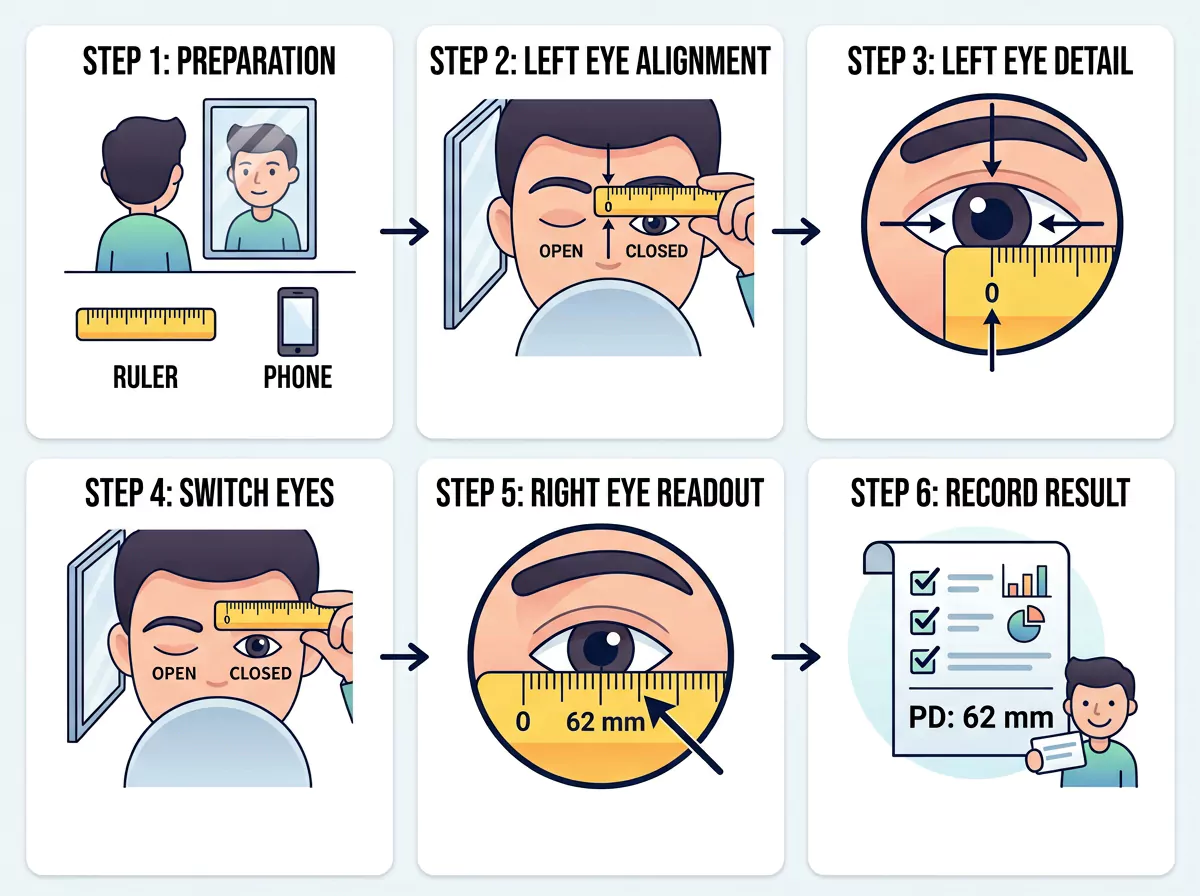
- Stand about 8‑12 inches (20‑30 cm) away from a mirror, at eye level.
- Hold a millimeter ruler flat against your brow (just above your eyes).
- Close your right eye.
- Line up the 0 mm mark with the center of your left pupil.
- Without moving your head, open your right eye and close your left eye.
- Read the number that aligns with the center of your right pupil – that’s your Single PD.
Tips: Repeat 3 times for consistency, and having a friend help makes it much easier.
Measure Dual PD at Home
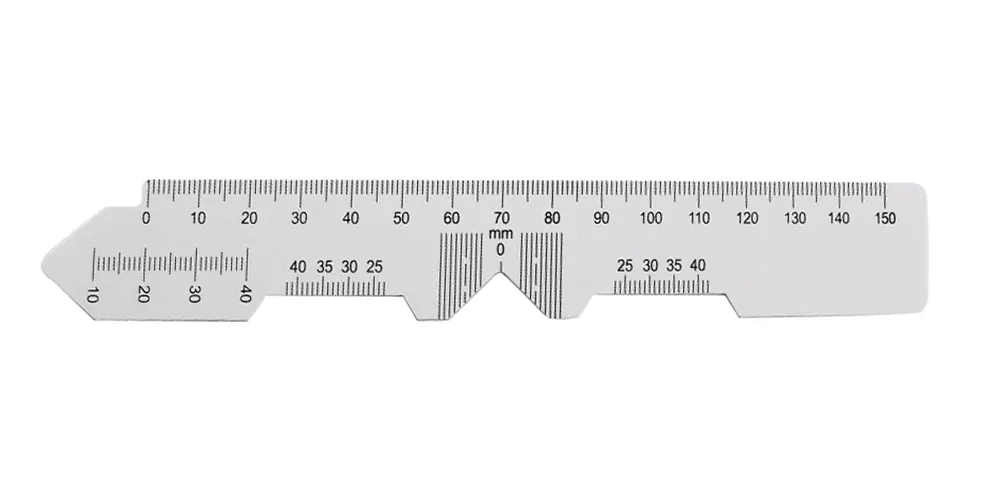
You’ll need a special ruler with a V‑shaped notch (many online retailers provide one for free):
- Stand in front of a mirror at the same distance.
- Place the V‑notch exactly on the bridge of your nose.
- Close your left eye and read the scale at the center of your right pupil – that’s your right eye PD.
- Close your right eye and read the scale at the center of your left pupil – that’s your left eye PD.
Use a Smartphone App
Many online eyewear stores now offer app‑based or web‑based tools that measure your PD using your phone’s camera. These can be reasonably accurate for simple prescriptions, but for progressives or strong corrections, a professional measurement is still best.
Common Questions
Need help measuring your PD?
Check out our PD measurement tool or contact our customer service team for guidance.