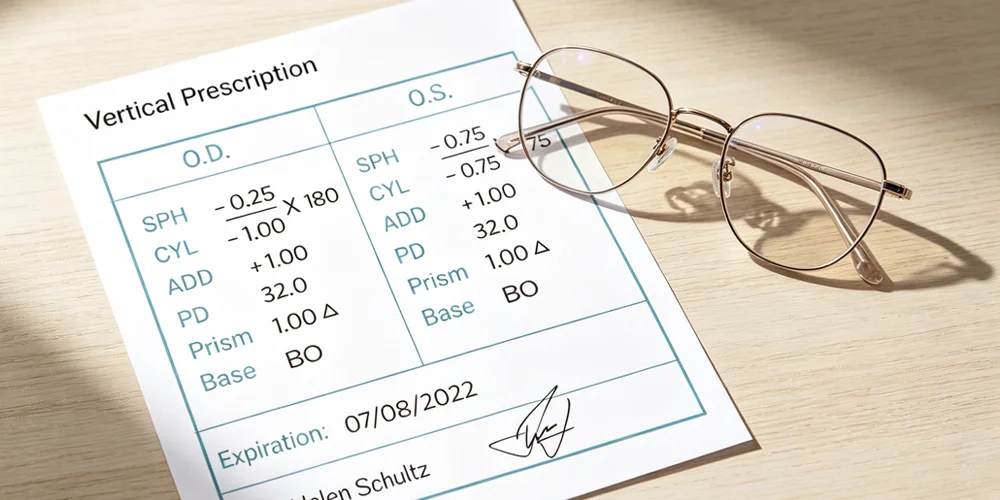
You just got your eye prescription and see a box labeled "ADD" – but have no idea what it means. Don't worry. This article breaks it down in plain English, so you'll know exactly what that number is for and why it matters.
What Exactly Is ADD?
ADD stands for Addition – it's the extra magnifying power added to the distance portion of your prescription to help you see clearly up close.
Think of it this way:
Distance prescription ADD = Near (reading) prescription
For example, if your distance prescription is –2.00 D (nearsighted) and your ADD is 2.00 D, your near prescription becomes 0.00 D (–2.00 2.00 = 0) . That means you'd see clearly at near without any correction .
Who Needs an ADD Number?
ADD typically appears on prescriptions for people over the age of 40 .
Why? Because as we get older, the natural lens inside our eye becomes less flexible . This makes it harder to focus on close objects – a condition called presbyopia .
Presbyopia isn't a disease; it's a normal aging process that everyone goes through . It usually starts around age 40–45 and shows up as :

- Holding books or phones farther away to read them
- Struggling to see in dim light when reading
- Eye fatigue or headaches after long periods of close work
ADD is the extra power that compensates for this loss of focusing ability .
What Does ADD Look Like on Your Prescription?
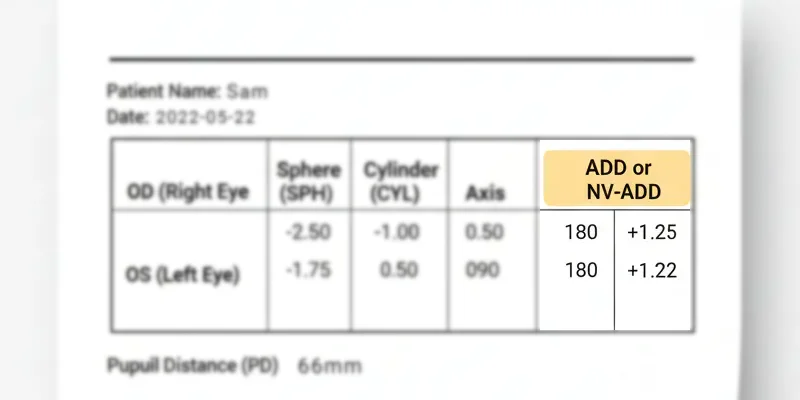
ADD is usually written at the bottom or in a separate section of your prescription . Here are common formats :
| Example Format | Meaning |
|---|---|
| ADD: 2.00 | 2.00 diopters of reading addition |
| ADD: 1.75 | 1.75 diopters |
| NVADD: 2.25 | 2.25 for near vision (NV = Near Vision) |
Key points to know:
- ADD is always a positive ( ) number .
- It's measured in diopters (D) – 1.00 D = 100 degrees .
- Typical range is 0.75 D to 3.50 D .
- ADD is almost always the same for both eyes .
What Kind of Lenses Need an ADD?
If your prescription includes an ADD, you need multifocal lenses – not single-vision lenses . Here are your options :
| Lens Type | What It Does |
|---|---|
| Progressive lenses | Seamless transition from distance (top) to near (bottom), with intermediate in between – one pair for all distances |
| Bifocal lenses | Two distinct zones – distance above, near below – with a visible line |
| Single-vision reading glasses | Entire lens set to the near power – used only for close work |
| Computer/office lenses | Optimized for intermediate distance (around arm's length), often with a custom ADD |
Common Questions About ADD
Your distance prescription corrects your vision for far away . ADD is the extra power on top of that to bring near objects into focus .
Formula: Near prescription = Distance prescription ADD
| Distance Rx | ADD | Near Rx |
|---|---|---|
| –3.00 D | 2.00 D | –1.00 D |
| 1.00 D | 2.00 D | 3.00 D |
| 0.00 D (plano) | 2.00 D | 2.00 D |
Absolutely . The accuracy of your ADD directly affects how comfortable your progressive lenses feel . If the ADD is off, you might experience :
- A reading zone that's too small or in the wrong place
- Needing to tilt your head awkwardly to read
- Blur or distortion in the near area
Summary – The Bottom Line
| What is ADD? | The extra power added to your distance Rx for near vision (also called "reading addition") |
| Who needs it? | People over 40 with presbyopia |
| Always positive? | Yes – it's a number, usually the same for both eyes |
| Common range | 0.75 D to 3.50 D |
| Lens types | Progressives, bifocals, or single-vision reading glasses |
| Check regularly? | Yes – because presbyopia worsens with age, have your eyes examined every 1–2 years |
One-sentence takeaway: ADD is your optometrist's way of telling the lab how much extra near power you need – so you can read your phone, your book, and your menu without holding them at arm's length .
Ready to order multifocal lenses?
Make sure your prescription includes a current ADD measurement. If you have any questions, our customer service team is here to help .