If you've ever ordered glasses online, you've probably seen a little box asking for your "PD." Here's everything you need to know — in plain English.
What Exactly Is PD?
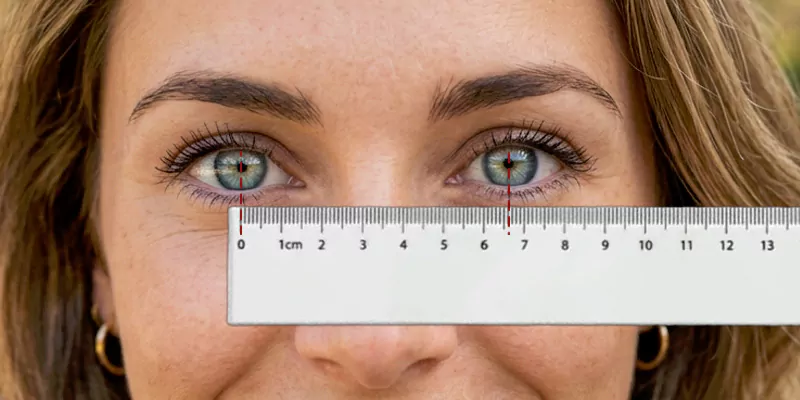
PD stands for pupillary distance — it's simply the distance between the centers of your two pupils, measured in millimeters.
Think of it like this: your eyes are two cameras. Your lenses are the viewfinders. PD tells the lens lab exactly where to place the "sweet spot" of each lens so it lines up perfectly with your eyes.
For most adults, PD falls somewhere between 54 and 74 mm. The average is around 63 mm.

Why Does PD Matter?
Here's the thing: even a perfect prescription won't give you clear vision if your PD is wrong.
When you get glasses made, the optical center of each lens needs to line up with your pupil. If that alignment is off, you're not looking through the clearest part of the lens.
What happens when PD is off?
- Blurry or "swimmy" vision — things don't look quite right
- Eye strain — especially after long hours on screens
- Headaches — your eyes are working too hard to compensate
- Dizziness or fatigue — your brain is trying to make sense of what it's seeing
People often describe it as feeling like wearing someone else's glasses. Everything feels slightly off, even if the prescription is technically correct.
PD matters even more if you have:
- A strong prescription (high plus or minus)
- Progressive or bifocal lenses — these have multiple vision zones that need precise alignment
- Prism correction in your lenses
Two Types of PD You Should Know About
When you're ordering glasses, you might see two different formats:
| Type | What It Means | When to Use |
|---|---|---|
| Single PD | One number (e.g., 63 mm) — distance from one pupil to the other | Most online orders ask for this |
| Dual PD (Monocular) | Two numbers (e.g., 31 / 32 mm) — distance from nose bridge to each pupil | More accurate, especially if your face isn't perfectly symmetrical |
Most people have slightly asymmetrical faces — one eye might be a millimeter or two closer to the nose than the other. Dual PD accounts for this and can give you a more precise fit.
Note: There's also a difference between Distance PD (for everyday wear) and Near PD (for reading glasses). Near PD is usually about 3 mm smaller because your eyes converge when you look at things up close.
How to Get Your PD
Option 1: Ask Your Eye Doctor (Best Choice)
The most accurate way to get your PD is to have an eye care professional measure it. They use a tool called a pupillometer — a digital device that gives a precise reading.
Option 2: Measure It Yourself at Home
If you can't get your PD from your eye doctor, you can measure it yourself. Here's the most common method:
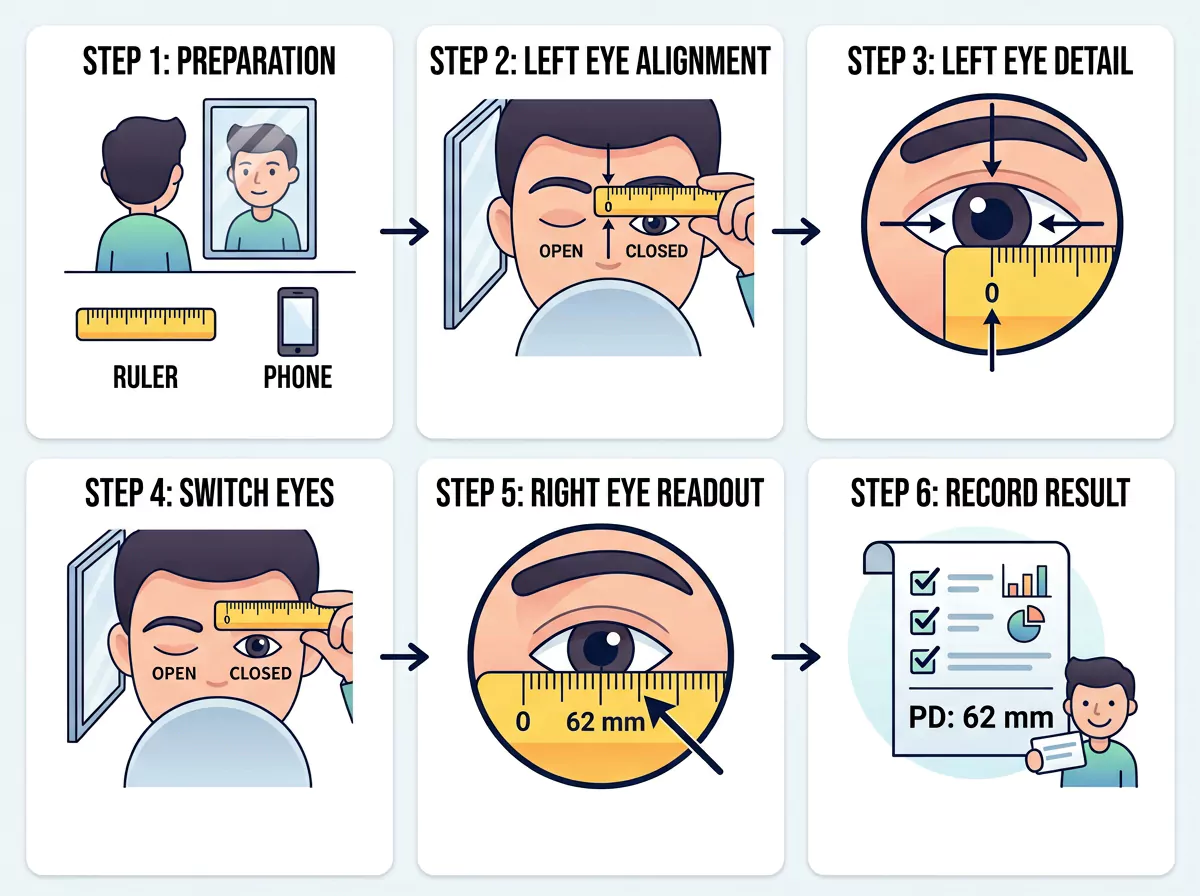
What you need: A millimeter ruler and a mirror.
Steps:
- Stand about 8-12 inches away from a mirror, at eye level
- Hold the ruler flat against your brow (just above your eyes)
- Close your right eye
- Line up the 0 mm mark with the center of your left pupil
- Without moving your head or the ruler, open your right eye and close your left eye
- Read the number that lines up with the center of your right pupil — that's your PD
Pro tips for accuracy:
- Use a millimeter ruler (not inches)
- Measure in bright, even light
- Keep your head straight (no tilting)
- Repeat 3 times and use the most consistent number
- Having a friend help makes it much easier
Option 3: Use a Smartphone App
Many online eyewear retailers now offer app-based PD measurement tools. These can be accurate for simple prescriptions, but results vary widely between apps. For progressive lenses or strong prescriptions, a professional measurement is still safest.
Common Mistakes to Avoid
This is the single most common error. Your PD is a precise number, not a flexible estimate.
Make sure you're using millimeters, not inches.
Measuring too close or too far — aim for about 8-12 inches.
Measure at least 3 times to check consistency.
The Bottom Line
PD might look like just another number on a form, but it's actually one of the most important measurements for your glasses. Get it right, and your glasses will feel natural and comfortable. Get it wrong, and even the most expensive prescription won't save you from headaches and blurry vision.
Take the time to get your PD right — your eyes will thank you.
Need help measuring your PD?
Check out our PD measurement tool or contact our customer service team for guidance.